Mykonos Travel Guide: Where to Stay, What to See and What It Costs
This mykonos travel guide covers Chora, Little Venice, Delos ferries, beaches and real 2026 prices, plus who should skip the island.
This guide may contain affiliate links. We may earn a commission at no extra cost to you. How this works.


In this guide
Mykonos is the most famous island in the Cyclades: white lanes, windmills, beach clubs and the ancient ruins of Delos half an hour offshore. Two full days covers the highlights, three days lets you slow down, and June or September gives you better weather, thinner crowds and lower prices than July and August. This guide covers where to stay, what to see, which beach to pick and what everything costs, so the most expensive island in Greece does not surprise you. Start with our other Greece guides if Mykonos is one stop on a wider trip.
How many days do you need in Mykonos?
Two full days is enough for the essentials. Spend day one in Chora: the windmills, Little Venice, the church of Panagia Paraportiani and dinner in the lanes. Take the morning boat to Delos on day two, then a beach afternoon.
Three days is the more comfortable version. The extra day buys Ano Mera village, a second beach on the opposite coast, and one evening out without checking your watch. Four or five days suits travellers who came for the clubs and beach restaurants rather than the sights. Mykonos pairs well with slower islands afterwards, so check our Greece itineraries before you lock in a full week here.
Where should you stay in Mykonos?
Chora, also called Mykonos Town, is the right base for most first visits. The windmills, Little Venice, the harbour, the Delos boats and both bus stations sit inside one walkable maze. The trade-off is noise and price: rooms above bar streets stay loud past 2am in season, and summer rates are the highest on the island.
Ornos and Platis Gialos suit beach-first trips. Both have sheltered water, tavernas and bus links back to town, and both run quieter at night than Chora. Agios Ioannis works for couples who want calm evenings with a view. Ano Mera suits travellers with a rental vehicle who prefer village prices to town prices.
Book early whatever you pick. The best rooms in Chora sell out months ahead for July and August, and last-minute bookings in peak weeks mean high prices for poor locations. See our Greece overview for how Mykonos fits beside quieter islands if prices shock you.
What should you see in Chora?
Chora is the attraction. Its lanes were laid out to confuse pirates, and they still confuse visitors, which is half the fun. Give it half a day on foot, early or late, because cruise groups fill the lanes between late morning and mid-afternoon.
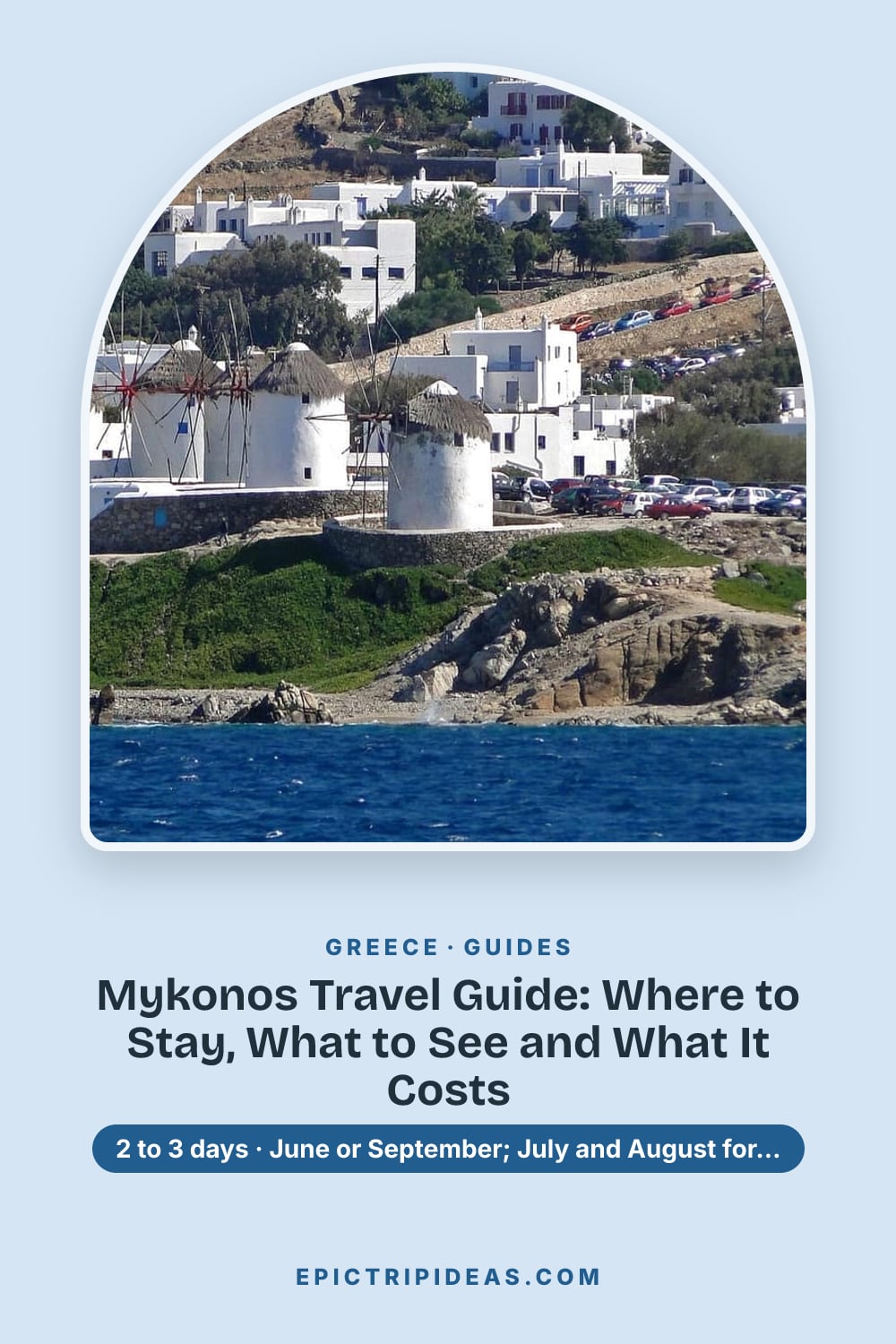
The Windmills of Kato Mili stand on the hill above the harbour: seven whitewashed 16th-century mills with thatched roofs, the postcard view of the island. Go at golden hour for the light over town, then again in the morning when you get the viewpoint almost alone. There is no entry fee and no opening time. It is a hilltop you walk to.
Little Venice sits below the windmills, a row of 18th-century sea captains’ houses with coloured wooden balconies hanging directly over the water. Every evening from about 7pm the waterfront fills for sunset, so arrive 30 to 40 minutes early or book a table if you want a seat rather than a standing spot.

The Little Venice waterfront at sunset hour, with Chora climbing the hill behind.
Panagia Paraportiani is the whitewashed church complex near the harbour, actually five small churches fused into one asymmetrical shape. It ranks among the most photographed buildings in Greece, and it photographs best in morning light before the crowds gather. The Kastro, the old castle quarter around it, holds the oldest lanes in town: narrow, stepped, easy to get lost in, free to wander.

The coloured balconies of Little Venice over the water on a bright day.
Two small museums repay an hour each before Delos. The Archaeological Museum near the Old Port holds finds from Delos and the island, and the Aegean Maritime Museum covers Cycladic seafaring. Both give context that makes the Delos ruins far more legible the next day.
Should you take the Delos day trip?
Yes. Delos is the single best excursion from Mykonos and one of the most important archaeological sites in the Mediterranean: the mythological birthplace of Apollo and Artemis, later a free port under Rome, now an uninhabited UNESCO-listed island. Budget a full morning, at least three hours on site.
Boats leave Mykonos Old Port Tuesday to Sunday at 9am, 10am and 11:30am, with returns at noon, 1:30pm and 3pm. Mondays get a single sailing out at 10am and back at 1:30pm (official 2026 schedule). The return ferry costs €25 (about $29/£21) and site entry with the museum costs €20 (about $23/£17), paid separately at the port kiosk and the site. A half-day guided tour with entry included costs €79 (about $91/£67). Buy at the Old Port on the morning you go rather than through marked-up resellers.

Standing columns among the ruins on Delos, a short boat ride from Mykonos.
Take the earliest boat. The site has almost no shade, summer temperatures pass 30C, and the only food is a small kiosk near the landing. Carry at least 1.5 litres of water per person, a hat and sunscreen. Do not miss the last boat back: overnight stays on Delos are strictly prohibited, and there is nowhere to eat or sleep. The Terrace of the Lions, the Sanctuary of Apollo and the House of Dionysus mosaics form the core loop, and the climb up Mount Kynthos adds about 45 minutes for views across the Cyclades.
Find experiences for your Mykonos trip
If you book through these links, we may earn a commission at no extra cost to you.Which beach should you pick?
Mykonos has more than 25 beaches, and they serve completely different trips. The south coast holds the organised clubs, the north and east hold the quiet coves, and the meltemi wind decides which side swims well on any given day. When the north wind blows hard from July into September, pick a sheltered south coast bay.
| Beach | Character | Prices in 2026 | Pick it if |
|---|---|---|---|
| Psarou | Sheltered glamour bay, Nammos and Cavo Psarou clubs | Nammos front-row pair €350 to €500 (about $400 to $580/£300 to £425) plus minimum spend; smaller operators from about €50 (about $58/£43); free public strip | You want the famous scene for a day, or just a swim on free sand |
| Paradise | The original party beach, DJs from morning | Loungers about €20 to €30 (about $23 to $35/£17 to £26); clubs Cavo Paradiso and Paradise Club at night | You want music, crowds and dancing in the sand |
| Super Paradise | Smaller party bay, mixed and LGBTQ+ welcoming crowd | Similar to Paradise, slightly calmer | You want the party with a friendlier edge |
| Platis Gialos | Practical family beach, tavernas, bus stop | Moderate, among the fairest on the south coast | You want calm water and an easy bus ride |
| Ornos | Sheltered, village feel, good for families | Moderate | You want to swim without a scene |
| Elia | Longest beach, organised and free sections | Moderate | You want space for a full beach day |
| Agios Sostis | No umbrellas, no bars, no music; locals’ favourite | Free sand; Kiki’s taverna for lunch | You want quiet and the clearest water |
| Fokos | Undeveloped, rough access road, almost empty | Free; Fokos Taverna needs a summer booking | You want to escape the island’s reputation entirely |
A water taxi links Platis Gialos with Psarou, Paraga and Paradise for about €5 (about $6/£4) per leg in season, which beats going back through town. Note the Psarou catch: the bay is public, so you can swim and lay a towel on the free strip, but front-row club beds need booking days ahead in July and August. Full-day bills at flagship clubs run into the hundreds per couple (2026 beach club prices), so check menus before you sit. Our Greek food guide covers what to order when lunch costs this much.
What does Mykonos cost in 2026?
Mykonos is the most expensive island in Greece, and honesty about that is the point of this section. Travellers who take the bus, eat at tavernas in Ano Mera and the back streets, and use free beaches manage €80 to €100 (about $92 to $115/£68 to £85) a day. A mid-range day with a Chora hotel, the Delos trip and taverna dinners with wine runs €200 to €250 (about $230 to $288/£170 to £213) per person. The beach club tier has no real ceiling. Cocktails at premium clubs run €18 to €25 (about $21 to $29/£15 to £21). A mid-tier club lunch runs €70 to €120 (about $81 to $138/£60 to £102) per person, and a front-row day at Nammos can pass €800 (about $920/£680) for two.
Nights out follow the same curve. Little Venice bars and Chora clubs charge €15 to €25 (about $17 to $29/£13 to £21) a cocktail in season, and big clubs add late-night entry once the beach venues wind down. It is resort pricing at European capital levels, so decide in advance which splurge days matter. Read our Greece budget guide for island-by-island cost comparisons before you commit.
For example, two people sharing a €50 pair of loungers from a smaller Psarou operator plus a €90 lunch with wine spend about €140 for the day. The same day from a Nammos front-row bed, with lunch and drinks, passes €800. The water is the same from both beds.
Cash still matters. Smaller tavernas and kiosks prefer it, and ATMs in Chora run low in peak weeks, so withdraw on arrival.
How do you get to Mykonos and get around?
Ferries from Athens use two ports. From Piraeus, high-speed boats take about 2 hours 40 minutes from around €53 (about $61/£45). Conventional Blue Star ferries take 4.5 to 5 hours from around €28 to €43 (about $32 to $49/£24 to £37) (current schedules). From Rafina, closer to Athens airport, high-speed boats take 2 hours 20 minutes from €52.50 (about $60/£45) and conventional boats from €38 (about $44/£32). High-speed boats land at the New Port in Tourlos, 2.5 km from town: take the port bus or a taxi (€8 to €12, about $9 to $14/£7 to £10) rather than walking it. Flights from Athens take 40 minutes, and direct European flights run all summer into Mykonos airport (JMK), 4 km from town.
On the island, the bus beats the taxi. Two hubs cover the island: Fabrika Square south of Chora for Paradise, Platis Gialos and Psarou, and the Old Port for Ornos, Agios Stefanos and Ano Mera. Rides cost €2 (about $2.30/£1.70) and run every 20 to 30 minutes in summer. There are only about three dozen licensed taxis on the whole island, they do not cruise for fares, and peak-season waits of 30 to 45 minutes at the main rank are normal. A car, scooter or ATV gives the most freedom for the north coast, but never drive into Chora itself: the lanes are pedestrian. See our Greece travel tips for ferry booking windows and island-hopping logic.
When is the best time to visit Mykonos?
June suits most travellers. Seas reach 22 to 24C, every club and restaurant is open, and crowds stay below the July and August peak (2026 season guide). September runs close behind, with the warmest water of the year at 26 to 28C, thinning crowds and softer prices.
July and August deliver the full spectacle at full price: packed beaches, booked-out clubs, the strongest meltemi winds and the highest hotel rates. If the party is the point, these are your months, and you should book rooms, club beds and sunset tables well ahead. The meltemi, a dry north wind, blows hardest in this window: it cools the 35C afternoons but chops up north-facing beaches, which is why the sheltered south coast matters.
May and October are the quiet alternative. Prices drop, lanes empty, and the architecture, food and Delos look after you. Some beach clubs open late or close early, so confirm before you plan days around them.
Who is Mykonos not for?
Say this plainly before booking. Mykonos is not for tight budgets: accommodation, food and beach prices run far above Naxos or Paros for the same week. It is not for travellers seeking quiet in July and August, when the town and south coast beaches stay loud all day. Light sleepers should avoid rooms over bar streets, and anyone who resents paying for sunbeds will feel charged at every turn.
The island is also not a cheap family pick in peak season, though Ornos and Platis Gialos work well outside it. If the prices above made you wince, you will have a better trip elsewhere in the Cyclades for half the money. If they did not, Mykonos repays the spend: dawn at the windmills, three hours on Delos, a swim at Agios Sostis while the meltemi blows, and dinner in Ano Mera village square. Browse our city guides for the next stop once the ferry leaves.
At a glance
Windmills of Kato Mili
Row of 16th-century whitewashed windmills on the hill above Chora, the best-known landmark on Mykonos.
- Address
- Mykonos, GR
Windmills of Kato Mili
Open in Google Maps ↗Know before you go
Greece at a glance
Best time to visit
May to June, September to October
- January: cool, some showers
- February: cool, some showers
- March: mild, some showers
- April: mild, mostly dry
- May: warm, some showers
- June: hot, some showers
- July: hot, mostly dry
- August: hot, mostly dry
- September: warm, some showers
- October: warm, mostly dry
- November: mild, some showers
- December: mild, some showers
Mostly dry Some showers
- Capital
- Athens
- Currency
- Euro (EUR)
- Language
- Greek
- Time zone
- EET, UTC+2
- Plugs
- Type C / F, 230 V
- Driving
- On the right
Emergency112
Frequently asked questions
How many days do you need in Mykonos?
Two full days covers Chora, Little Venice, one beach and the Delos half-day trip if you start early. Three days is more comfortable and leaves room for Ano Mera and a second beach. Stay longer only if beach clubs and late nights are the point of the trip.
Where should I stay in Mykonos for the first time?
Chora (Mykonos Town) suits most first visits: the windmills, Little Venice, the Old Port boats to Delos and the main bus stops are all on foot. Ornos and Platis Gialos suit travellers who want calm water and a beach base. Book months ahead for July and August.
How much does the Delos day trip cost in 2026?
The return boat from Mykonos Old Port costs €25 (about $29/£21) and entry to the site and museum costs €20 (about $23/£17), both payable at the port and the site. A half-day guided tour with entry included costs €79 (about $91/£67). Boats run Tuesday to Sunday at 9am, 10am and 11:30am, with a single Monday sailing at 10am.
Is Mykonos expensive?
Yes, it is the priciest island in the Cyclades. A mid-range day with a hotel in Chora, the Delos trip and taverna dinners runs €200 to €250 per person. A front-row sunbed pair at Nammos on Psarou costs €350 to €500 before food and drinks, though Psarou keeps a free public strip of sand. Buses (€2), back-street tavernas and free beaches keep costs down.
When is the best time to visit Mykonos?
June and September suit most travellers: warm seas, open clubs and lower prices than peak. July and August bring the full party season with maximum crowds, maximum prices and the strong meltemi wind. May and October are quiet and cheap, but some beach clubs stay closed.
Who is Mykonos not for?
Travellers on a tight budget, anyone seeking quiet or solitude in July and August, and visitors who dislike crowds will struggle here. Light sleepers should avoid rooms above Chora bar streets. If that sounds like you, Naxos or Paros give you Cycladic lanes and beaches at far lower prices.
Useful links (6)
- Delos Tours, official 2026 schedule and prices— delostours.gr
- Mykonos Travel Guide 2026, TourMe— tourme.app
- Psarou Beach sunbed prices and free section 2026— daytripsfrommykonos.com
- Mykonos beach club prices 2026— greekislandinfo.com
- Piraeus to Mykonos ferry times and prices, Ferryhopper— ferryhopper.com
- Rafina to Mykonos ferry times and prices, Golden Star Ferries— goldenstarferries.com
Photo credits
Thank you to Bernard Gagnon, Julian Lupyan and PLBechly for sharing these beautiful photographs and helping bring this guide to life.
Editorial byline
Emma Collins Croatia, Greece and Turkey editor
Emma covers Croatia, Greece and Turkey for Epic Trip Ideas: city breaks, island hops, ferry routes, where to eat and what a trip really costs. Emma Collins is a pen name the Epic Trip Ideas editors use for Croatia, Greece and Turkey; every guide is checked against official sources before it goes live.