Marrakech Travel Guide: Opening Hours, Ticket Rules and 2026 Costs
Plan Marrakech with real 2026 rules: online-only Majorelle tickets, Friday crowds at the Saadian Tombs, museum closure days, airport transport, day costs.
This guide may contain affiliate links. We may earn a commission at no extra cost to you. How this works.

In this guide
Marrakech rewards three to four days, but the plan matters more than the list of sights. The city’s headline sites run on three different ticketing systems, and they do not close on the same days. Jardin Majorelle sells online only. The state-run palaces open every day of the week. The smaller museums shut on staggered weekdays that catch visitors out. This Marrakech travel guide builds your days around those rules, prices every core ticket in dirhams, and sums each day’s total. Every fare and opening hour was checked against official pages in October 2026.
Key Takeaways
- Book Jardin Majorelle before you fly. Tickets are sold online only, at 170 dirhams for the garden (official site, October 2026).
- Route around the closure calendar: Dar el-Bacha and the Museum of Intangible Heritage shut on Mondays, MACAAL adds Tuesday, and the Yves Saint Laurent Museum shuts on Wednesday.
- Keep the Saadian Tombs for a non-Friday morning. Moroccan nationals enter free every Friday, which fills the chambers while you still pay 100 dirhams.
- Three headline sights in one medina day cost 250 dirhams, summed from the table below.
- Airport bus 19 costs 30 dirhams. A prepaid taxi runs 100 to 160 dirhams by day, depending on the zone.
Build the plan around opening rules
Marrakech has no single ticket desk. Three systems sit side by side, and mixing them up costs a morning.
The Ministry of Culture ticket office is the single desk that sells the Saadian Tombs and the Badii Palace. It publishes one schedule for its monuments: 9am to 5pm daily, with no weekly closing day. A foreign adult pays 100 dirhams at each, a Moroccan or resident adult 30 (ministry ticket page). The Bahia Palace is listed at the same 100 dirhams on a private operator’s page, which itself says to confirm at the gate (Bahia Palace entrance fee).
The tariff hides a trap. Moroccan nationals enter free every Friday and on the first day of national and religious holidays. You do not. Friday afternoons are the busiest hours of the week inside the tombs and across the palace ruins, while a visitor pays the full 100 dirhams for the fullest version of the same site. Thursday or Saturday morning buys you the same stones with a fraction of the crowd.
Jardin Majorelle runs its own system. Tickets are sold online only, at 170 dirhams for the garden (the booking site also offers a garden plus Pierre Bergé Museum of Berber Arts ticket, whose price shows only inside the booking flow) (official garden page). There is no window to queue at. Buy before you fly, then arrive at the 8am opening. Closing time shifts by season, and the official pages list both 5:30pm and 6:30pm, so check your ticket. The Yves Saint Laurent Museum next door charges 140 dirhams and shuts on Wednesdays, so a Wednesday arrival sends that visit elsewhere.
The smaller museums each keep their own door and their own closing day. That is where first itineraries break:
| Day | Shut | Do instead |
|---|---|---|
| Monday | Dar el-Bacha, the Museum of Intangible Heritage and Dar Bellarj. MACAAL is shut as well. | Gueliz, the Maison de la Photographie, or a day trip out of the city. |
| Tuesday | MACAAL only. | Any medina sight you like. |
| Wednesday | The Yves Saint Laurent Museum. | The Bahia Palace, the Saadian Tombs or the Ben Youssef Madrasa. |
| Friday | Nothing shuts, but free entry for Moroccan nationals fills the ministry sites. | Arrive at the 9am opening, or pick a different day. |
The details behind that table come from the museums themselves. Dar el-Bacha opens Tuesday to Sunday from 10am to 6pm at 60 dirhams and closes Mondays (museum page). MACAAL, reopened after the 2023 earthquake, runs Wednesday to Sunday from 10am to 6pm at 120 dirhams, shut on Mondays and Tuesdays (practical information). The Museum of Intangible Heritage follows the same Tuesday-to-Sunday pattern at 40 dirhams. One useful survivor of the earthquake era: Dar Si Said and the Tiskiwin Museum are both listed as closed for works in October 2026, so drop them from any list built from an older guidebook.
Where to stay in Marrakech
Medina is the walled old city, a UNESCO World Heritage Site of alleys, souks and courtyard houses. Cars barely reach it, so your bags usually travel the last hundred metres by hand.
Riad is a traditional townhouse built around an internal courtyard, often with a small pool and a roof terrace. From the alley you see a plain wall and a door. Inside it is quiet and cool.
| Area | Best for | Keep in mind |
|---|---|---|
| Medina near Jemaa el-Fna | First-timers who want everything on foot | Noise from the square until late. |
| Mouassine and the north medina | Design riads, galleries, calmer alleys | Easy to lose your bearings. |
| Kasbah, south medina | Palaces on the doorstep, quieter nights | Further from the souks. |
| Gueliz and Hivernage | Modern hotels, bars, the train station | You will taxi to the medina. |
Ask your riad to send someone to meet the car on your first arrival. Mapping apps get the alleys wrong more often than right, and finding a door in the dark with luggage is a classic first-night ordeal. Most hosts offer the pickup for free.
A four-day plan built around the rules
Four days gives you a full day for the square and souks, one for the Gueliz gardens, one for the palaces, and one spare for a closure or a trip out. Three days works if you cut the spare day. Two days forces a choice between the Kasbah and the gardens, which is the choice most first visits regret.
Day 1: land, drop bags, watch the square. Keep it light. Jemaa el-Fna is the open square at the foot of the souks, and UNESCO lists its storytellers, musicians and public performers as a masterpiece of intangible heritage (UNESCO entry). Juice stalls work the morning side, henna artists the afternoon, and numbered food stalls take over after dark. Watch the change from a rooftop cafe, then eat where the queues are local. For example, a 9pm landing turns day one into a square-and-dinner day, and that is a good outcome.

Jemaa el-Fna in the late afternoon, before the food stalls light up.
Day 2: the Gueliz gardens morning. Book Majorelle first, because the ticket rule does the planning for you. The garden opens at 8am, so that first slot is the cool one and the least crowded. Budget 170 dirhams for the garden, plus whatever the booking page shows if you add the Berber museum. If Wednesday falls here, swap the Yves Saint Laurent Museum for Le Jardin Secret in the medina, which opens every day of the week at 100 dirhams for the garden and 40 more for the tower (garden information).
Day 3: the Kasbah and the madrasa. Start at the 9am opening. The Saadian Tombs come first: 100 dirhams, marble graves and the Chamber of the Twelve Columns, and about 45 minutes if the queue has not formed. The Badii Palace sits a few hundred metres away for the same 100 dirhams, and its ramparts are the best value view over the medina. After lunch, walk north to the Ben Youssef Madrasa for 50 dirhams, open daily from 9am to 7pm and shortened to 4:30pm during Ramadan (official hours and prices).

The Chamber of the Twelve Columns at the Saadian Tombs. Go at the 9am opening, and not on a Friday afternoon.
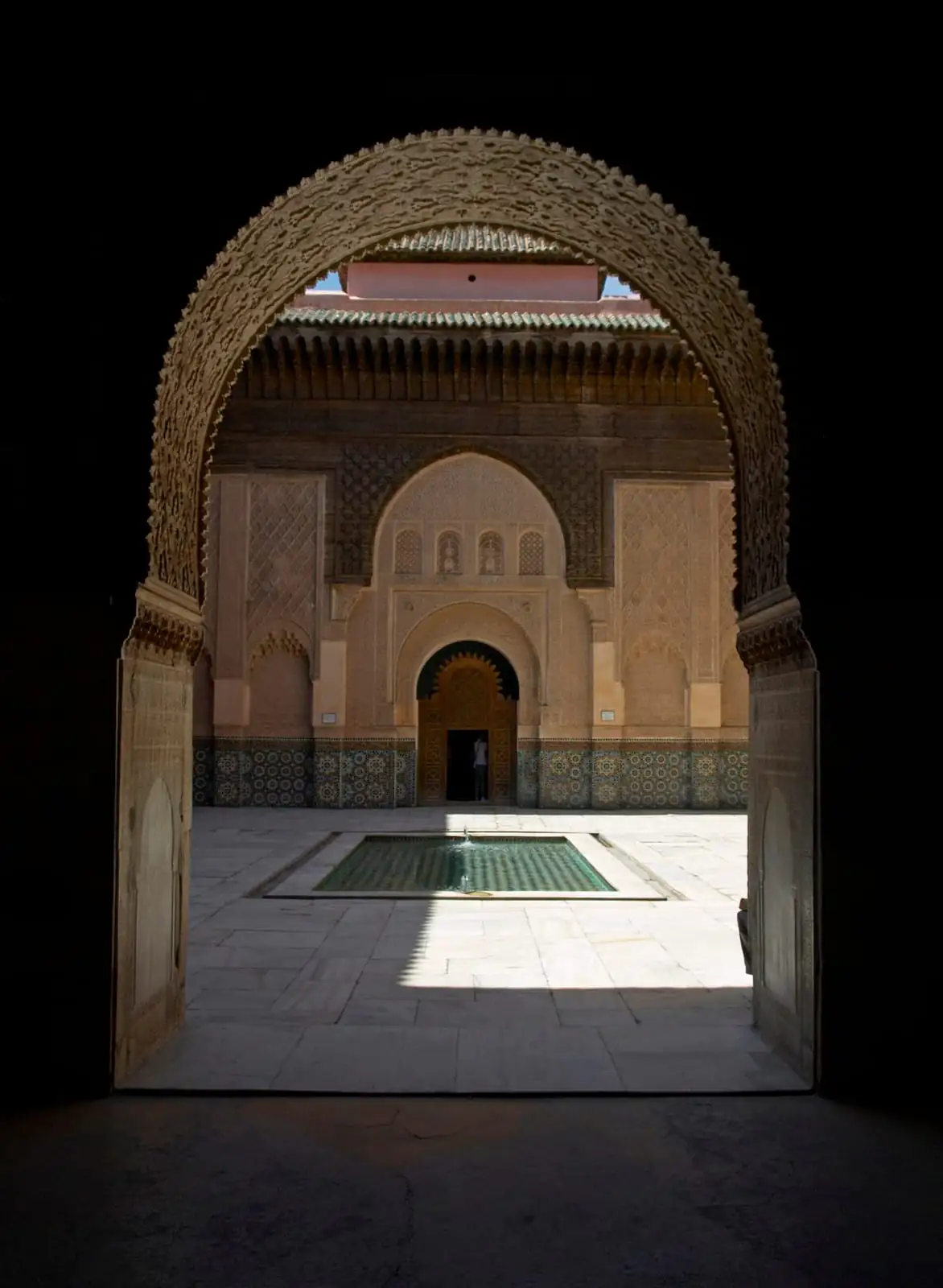
The main courtyard of the Ben Youssef Madrasa, restored in 2022 after four years of work.
Day 4: choose by the calendar. A Monday sends you to the Maison de la Photographie, open daily from 9:30am to 7pm at 80 dirhams, or out of the city entirely. The Ourika Valley in the Atlas foothills takes about an hour each way. Public coaches to Essaouira leave from the Gueliz station, and the Atlantic wind makes a useful change after two days in the medina (Essaouira travel guide). If sand matters more than sea, our Sahara desert guide covers the long drive south.
What the tickets cost in 2026
Dirham is Morocco’s currency, written MAD on tickets and price boards. Cards work in hotels and larger shops, but the square, the palaces and the taxi desk run on cash.
Every figure below is per adult, in dirhams, for a foreign visitor, checked against the official pages linked in the sections above in October 2026. Moroccan and resident rates run lower almost everywhere.
| Sight or ride | Cost in 2026 | Hours and rules |
|---|---|---|
| Jardin Majorelle, garden only | 170 | Daily from 8am, closes 5:30pm to 6:30pm by season. Online only. |
| Majorelle with the Berber museum | See booking page | Same grounds, one ticket. |
| Yves Saint Laurent Museum | 140 | 10am to 6pm. Shut Wednesday. |
| Bahia Palace | 100 | Daily 9am to 5pm. |
| Saadian Tombs | 100 | Daily 9am to 5pm. Moroccans free on Fridays. |
| Badii Palace | 100 | Daily 9am to 5pm. Same Friday rule. |
| Ben Youssef Madrasa | 50 | Daily 9am to 7pm, 4:30pm in Ramadan. |
| Le Jardin Secret | 100, tower 40 extra | Open daily; 9:30am to 6pm in October. |
| Dar el-Bacha | 60 | Tuesday to Sunday, 10am to 6pm. Shut Monday. |
| MACAAL | 120 | Wednesday to Sunday, 10am to 6pm. Shut Monday and Tuesday. |
| Museum of Intangible Heritage | 40 | Tuesday to Sunday, 10am to 6pm. Shut Monday. |
| Maison de la Photographie | 80 | Daily 9:30am to 7pm. |
| Bus 19 from the airport | 30 | About every 20 minutes, 6am to 9:30pm. |
| City bus on the ALSA network | 4 | All routes, cash. |
Three day shapes, summed from the fares above, cost this much before food and beds:
- Medina classics: Saadian Tombs 100, Bahia Palace 100 and Ben Youssef Madrasa 50 total 250 dirhams.
- Gueliz gardens morning: Majorelle 170 plus the Yves Saint Laurent Museum 140 is 310 dirhams. Drop the museum on a Wednesday.
- Indoor escape: Le Jardin Secret 100, Dar el-Bacha 60 and the Museum of Intangible Heritage 40 come to 200 dirhams, which is the plan for a day too hot to walk.
For example, a first full day that pairs the Saadian Tombs with the Bahia Palace and two city bus rides lands near 210 dirhams per person. That sits inside a budget day of about 600 dirhams including a simple riad double, meals and a taxi. The country-wide numbers live in our Morocco trip cost breakdown.
Find experiences for your Marrakech trip
If you book through these links, we may earn a commission at no extra cost to you.Getting in and getting around
Marrakech Menara airport sits about 6 km from the medina edge. You have three honest options.
- Bus 19: 30 dirhams a seat, about every 20 minutes between 6am and 9:30pm, with the stop at Jemaa el-Fna at one end (city transport page). For example, a morning landing with one bag makes bus 19 the easy choice.
- Prepaid taxi: the desk inside arrivals works off a posted zone grid. Expect 100 to 160 dirhams to the city by day depending on the zone, with about half again as much at night, plus a small desk fee. Agree the zone and the total before the car moves, and ignore anyone who approaches you inside arrivals offering a ride.
- City buses: the ALSA network crosses town for 4 dirhams a trip (city transport page).
By train, ONCF runs from Casablanca to Marrakech in about three hours. Check times and fares on the ONCF site before you go, since they change by service. The station sits in Gueliz, one short taxi ride from the medina walls.
Inside the medina, walk. Map apps confuse the alleys more than they help. Ignore anyone who tells you a sight is closed today or offers to lead you somewhere for free. Both are the opening moves of a commission. Our Morocco travel tips cover the haggling, the touts and the taxi habits in detail. Petits taxis, beige in Marrakech, earn their keep at the end of a Gueliz evening: expect 30 to 50 dirhams across town with the meter on, and carry small notes because drivers rarely change a large bill.
The souks, the square and what to eat
The souks start just north of Jemaa el-Fna and run for kilometres. Lanes specialise: leather, metalwork, lamps, spices, carpets, textiles. Nothing has a fixed price. Open well under the first number, and walk away politely if it never gets close.

Lamp sellers in the covered souks, north of the square.
You do not need a guide for the lanes. A licensed guide booked through your riad for two or three hours is a different purchase from the men at the entrances who offer directions and then name a price. Consider taking one for a morning if the history of the trades matters more than the shopping.
At the square, look for grilled meats, harira soup and snail broth. Tanjia is the Marrakech speciality, lamb slow-cooked in a clay urn in the ashes of a hammam fire. Orange juice runs about 4 dirhams at the local price and about 15 when the stall is aimed at visitors (prices checked August 2026). Change your large notes before you reach the food stalls, because the change float does not stretch to a 200 dirham note. Our Moroccan food guide covers what to order in the rest of the country.

Juice and fruit stalls near the square. The local price and the visitor price are not the same number.
A hammam finishes the day. Local public hammams cost very little but are basic and split by gender with no appointment. Spa hammams in riads are private, comfortable and dearer. Nothing in between needs booking weeks ahead.
What to skip
- Majorelle at midday without a ticket. The garden sells online only, so a walk-up plan is a wasted taxi ride.
- The Saadian Tombs on a Friday afternoon. You pay 100 dirhams for the fullest hour of the week.
- Stacking Dar el-Bacha with MACAAL on a Monday. Both shut, and Tuesday still loses MACAAL.
- Unofficial guides at the souk entrances. Book licensed through your riad instead.
- Paying in euros at the square. The official rate sits near 10.7 dirhams to the euro in 2026, and street offers are always worse.
- A packed first afternoon after a morning flight. The heat and the tiredness land together, and the medina is the worst place to negotiate either.
When to visit Marrakech, and how long to stay
Spring, from March to May, and autumn, from October to November, give the best months: warm days, cool evenings and clear views of the Atlas. Summer passes 40C regularly, and the medina is hardest work from midday to late afternoon. Winter days stay sunny and mild, but nights turn cold, and riads built for heat can feel chilly without an extra layer. Our best time to visit Morocco guide runs month by month for festivals and price swings.
Ramadan changes the rhythm of the day. In 2027 it is expected to start on Monday 8 February, subject to the moon sighting that Morocco’s Ministry of Habous announces on the evening of 29 Sha’ban. Many cafes close by day, sights shorten their hours, MACAAL for example closes at 3:30pm, and the city comes alive after sunset. Treat any 2027 date as provisional until the announcement.
Health advice is short. The CDC’s Morocco page covers vaccinations, food and water precautions, and insect bites. Treat tap water as something for washing, drink bottled or filtered water, and let the mint tea handle the rest. Marrakech stays generally safe for visitors; the realistic risks are pickpocketing in crowds, persistent touts, and henna artists who start before you have agreed a price. Keep one card and most of your cash split across pockets.
How this fits a wider Morocco trip
Three or four days is the right dose for the city on its own. With a week, add Essaouira on the coast or a night in the Atlas foothills. The seven days in Morocco route shows how Marrakech sits on a classic first trip, and the Morocco trip cost breakdown carries these dirham figures into a full-country budget.
How this page is checked: every ticket price, opening hour and fare in this guide was fact-checked in October 2026 against the official ministry, museum and city pages linked beside it, by the same methodology as this site. The about page explains our editorial standards.
At a glance
Jemaa el-Fna
The main square of Marrakech's medina, a UNESCO-listed Masterpiece of the Oral and Intangible Heritage of Humanity.
- Address
- Marrakech, MA
Jemaa el-Fna
Open in Google Maps ↗Know before you go
Morocco at a glance
Best time to visit
March to May, September to November
- January: mild, some showers
- February: mild, some showers
- March: mild, some showers
- April: mild, some showers
- May: warm, mostly dry
- June: warm, mostly dry
- July: warm, mostly dry
- August: warm, mostly dry
- September: warm, mostly dry
- October: warm, some showers
- November: mild, some showers
- December: mild, some showers
Mostly dry Some showers
- Capital
- Rabat
- Currency
- Moroccan dirham (MAD)
- Language
- Arabic, Tamazight (French widely used)
- Time zone
- UTC+1 (UTC+0 during Ramadan)
- Plugs
- Type C / E, 220 V
- Driving
- On the right
Emergency19 police, 15 ambulance
Frequently asked questions
How many days do you need in Marrakech?
Three days covers the medina, Jardin Majorelle, the palaces and a hammam at a relaxed pace. Add a day or two for the Atlas Mountains or the Agafay desert, or more if you're combining Marrakech with a wider Morocco trip.
Is Marrakech safe for tourists?
Marrakech is generally safe, but pickpocketing and persistent touts are common in the medina. The main risks are scams: fake 'the square is closed today' guides, unrequested directions followed by a demand for money, and henna artists who start before you agree a price.
What should I wear in Marrakech?
Loose clothing that covers shoulders and knees is comfortable and respectful, for men and women. It helps in the heat and reduces unwanted attention in the medina.
How do I get from Marrakech airport to the medina?
Bus 19 runs between the airport and Jemaa el-Fna for 30 dirhams one way, roughly every 20 minutes from 6am to 9:30pm. Prepaid airport taxis charge a posted zone fare of about 100 to 160 dirhams by day, with about half again as much at night; agree the zone before the car moves. Many riads arrange a pickup, which is the easiest option after dark.
Do you need a guide in the Marrakech souks?
No, though a licensed guide for two or three hours can help on a first visit if you want context on the different trades rather than just directions. Unofficial guides who approach you on the street are usually working toward a commission at a shop; a hotel or riad can book a licensed one for a fair price.
Can you drink tap water in Marrakech?
Travel health advice still recommends bottled or filtered water for visitors, since a change in mineral content can cause stomach upsets in people whose gut isn't used to it. Mint tea, coffee and bottled water are the safe defaults.
Useful links (10)
- Jardin Majorelle: the garden and tickets (official site)— jardinmajorelle.com
- Badii Palace ticket page, Ministry of Culture— e-services.minculture.gov.ma
- Medersa Ben Youssef: opening hours and ticket prices (official)— medersabenyoussef.ma
- Bahia Palace entrance fee— bahiapalace.com
- Dar el-Bacha Museum of Confluences, Fondation Nationale des Musées— fnm.ma
- MACAAL practical information (official)— macaal.ma
- Le Jardin Secret: hours and admission (official)— lejardinsecretmarrakech.com
- Marrakech city transport, official tourism office— visitmarrakech.com
- Morocco travel health advice, US CDC— wwwnc.cdc.gov
- Jemaa el-Fna Square, UNESCO Intangible Cultural Heritage— ich.unesco.org
Photo credits
Thank you to Viault for sharing this beautiful photograph and helping bring this guide to life.
First published
Editorial byline
Jack Roberts Africa editor
Jack covers Morocco and Zanzibar for Epic Trip Ideas: medinas, desert routes, street food and Indian Ocean islands, with the logistics and costs sorted. Jack Roberts is a pen name the Epic Trip Ideas editors use for Morocco and Zanzibar; every guide is checked against official sources before it goes live.


